
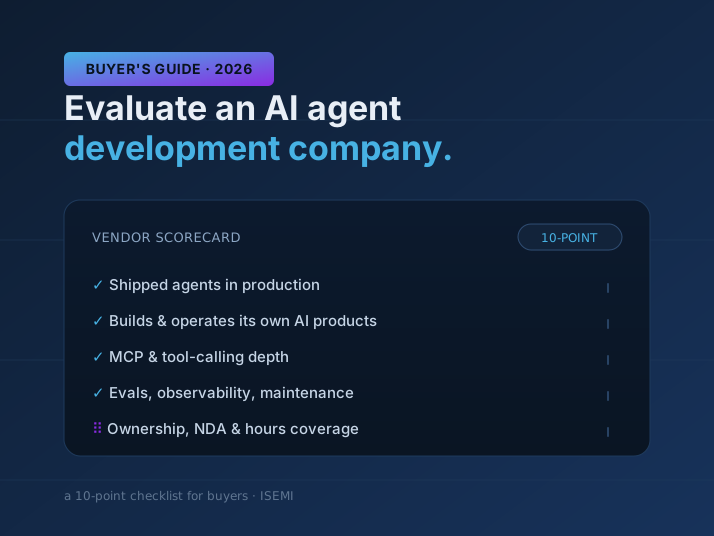
An AI agent development company is a firm that designs, builds, and operates software agents — systems that use large language models to plan a task, call tools and APIs, and complete multi-step work with limited human supervision. It is not the same as a generic software shop that happens to add a chatbot. An agent makes decisions at runtime, and that single difference should reshape how you evaluate the vendor you hire to build one.
This is a 2026 buyer's guide for that decision. If you are comparison-shopping vendors, scoping a build, or writing the shortlist yourself, the checklist below is designed to be run against every name on your list. It scores the things that actually predict whether an agent survives contact with production — not the things that look good in a demo.
Why vetting an agent company is different
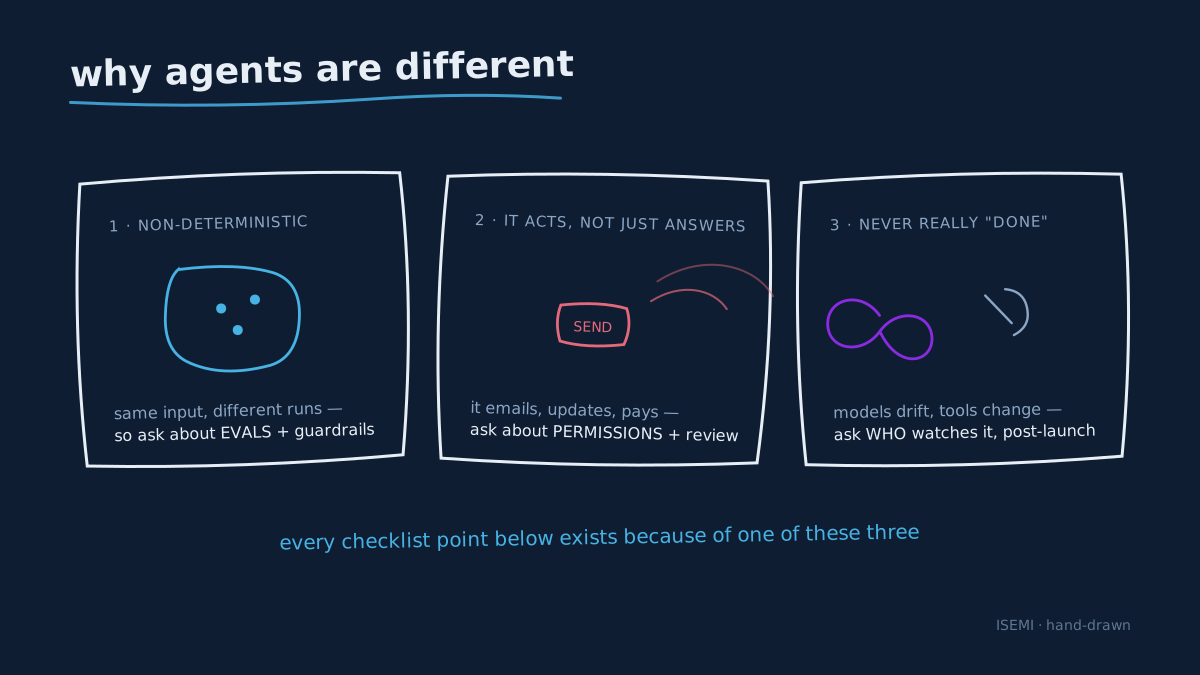
Vetting a normal development shop is mostly about craft and delivery: can they write clean code, hit a deadline, and communicate. Those still matter. But an AI agent is a different kind of artifact, and three properties change the evaluation.
First, an agent is non-deterministic. The same input can produce different actions on different runs. A vendor who has only shipped deterministic software often underestimates how much work goes into making a probabilistic system behave reliably — the evaluation harnesses, the guardrails, the fallback paths.
Second, an agent acts, it does not just answer. It sends the email, updates the ticket, moves the money. The blast radius of a bug is larger than a wrong string on a page, so the vendor's discipline around permissions, testing, and human-in-the-loop review is a first-class concern, not a nice-to-have.
Third, an agent is never really "done". Models change, tools change, the data drifts. A company that treats an agent like a fixed-scope website — build it, hand over a zip, disappear — is selling you a liability. The right question is not only "can they build it" but "will it still work in six months, and who is watching."
Hold those three properties in mind as you work through the checklist. Each point exists because of one of them.
The 10-point evaluation checklist
Score each vendor from 0 to 2 on every point (0 = no evidence, 1 = partial, 2 = strong, demonstrated). A vendor that clears most of these is rare; use the score to compare, not to demand perfection.
1. Have they shipped agents to production — not demos?
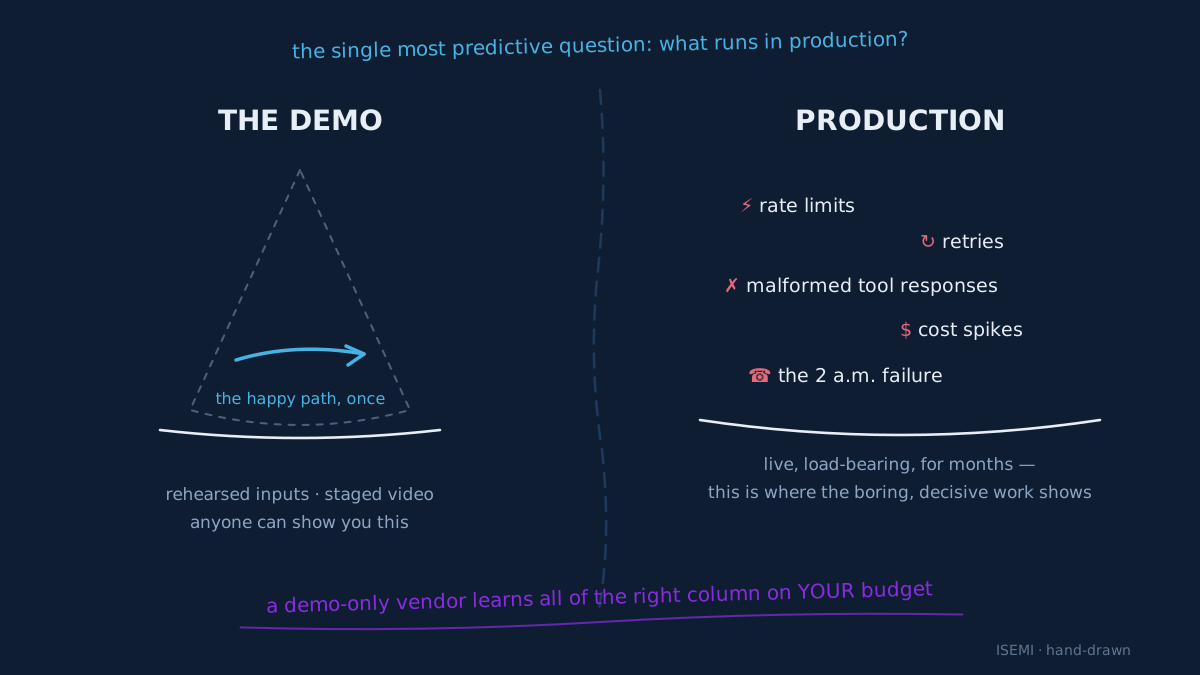
The single most predictive signal. Anyone can show a slick demo where the happy path works once on stage. Ask for agents that are live, in front of real users or inside a real operation, right now, and have been for months. Production is where the boring, decisive work shows up: rate limits, retries, malformed tool responses, cost spikes, the 2 a.m. failure. A vendor who has only built proofs-of-concept will learn all of that on your budget.
2. Do they build and operate their own AI products?
There is a meaningful difference between a shop that only bills hours and one that also carries the risk of running its own software. A company that operates its own AI products feels every rough edge its clients feel — the on-call pages, the model regressions, the bill at the end of the month. That operating experience is hard to fake and hard to buy. At ISEMI this is our default posture: we build and operate our own AI products, so the muscle we bring to a client roadmap is the same one we use on ourselves.
3. How deep is their tool-calling and MCP work?
An agent is only as useful as the tools it can reach. Ask specifically about tool-calling design and Model Context Protocol (MCP) experience: how they expose systems to the agent, how they handle authentication and scoping, how they keep a tool call from doing something irreversible. Depth here separates teams that can wire an agent into your real stack — your ticketing, your CRM, your data warehouse — from teams that can only call one model API and parse the text.
4. Do they have a real evaluation and testing practice?
Because agents are non-deterministic, "we tested it" has to mean something specific. A serious vendor runs evals: a suite of representative tasks scored automatically, tracked over time, and re-run whenever a prompt, model, or tool changes. Ask to see how they measure quality, how they catch regressions before you do, and what their process is when a model update quietly changes behaviour. If the answer is "we click around," keep looking.
5. Who owns the code, the data, and the IP?
Read this into the contract, do not take it on trust. You should own the source code, the prompts, the eval sets, and the data the agent touches, with no lock-in that makes leaving expensive. Confirm the vendor will not train third-party models on your data, and that an NDA is signed before anything sensitive changes hands. Ownership and confidentiality are where a good engagement quietly protects you and a bad one quietly traps you.
6. Is the engagement model clear and honest?
You should be able to understand, on one page, how they start and how they bill. Mature vendors usually offer a small discovery sprint to de-risk scope before a full build, then a path to production, then an operating arrangement. Vague pricing, an insistence on a huge upfront commitment before any scoping, or an inability to describe a first small step are all signs the vendor is managing their risk by transferring it to you.
7. Can they observe agents in production?
When an agent does something wrong, can they tell you why? Ask about observability: tracing of each agent run, logging of tool calls and decisions, dashboards for cost and latency, alerting when quality drops. Without this, debugging a live agent is guesswork, and every incident becomes a multi-day investigation. With it, most incidents are a traced run and a one-line fix.
8. Are they model- and framework-agnostic?
The model landscape changes every few months. A vendor married to a single model or a single orchestration framework will either lock you into that choice or rebuild expensively when it stops being the best option. Prefer teams that reason about trade-offs — this model for reasoning, that one for cost, this framework for this shape of problem — and design so a swap is a configuration change, not a rewrite.
9. Who maintains the agent after launch?
Ask the uncomfortable question directly: after go-live, who keeps this working, and on what terms? Models get deprecated, APIs change, usage patterns shift. Find out whether maintenance is an ongoing arrangement or an afterthought, what the response time is when the agent breaks, and whether the people who built it are the people who will fix it. An agent with no maintenance plan is a countdown, not an asset.
10. Does their working-hours coverage fit yours?
An agent that acts on your business needs someone reachable when it misbehaves. You do not need a vendor in your exact city, but you do need overlap and coverage that matches where your operation runs and when it matters. Distributed teams that cover US, EU, and APAC working hours can watch an agent across time zones; a team available only a few hours a day, offset from yours, turns every incident into an overnight wait.
Red flags
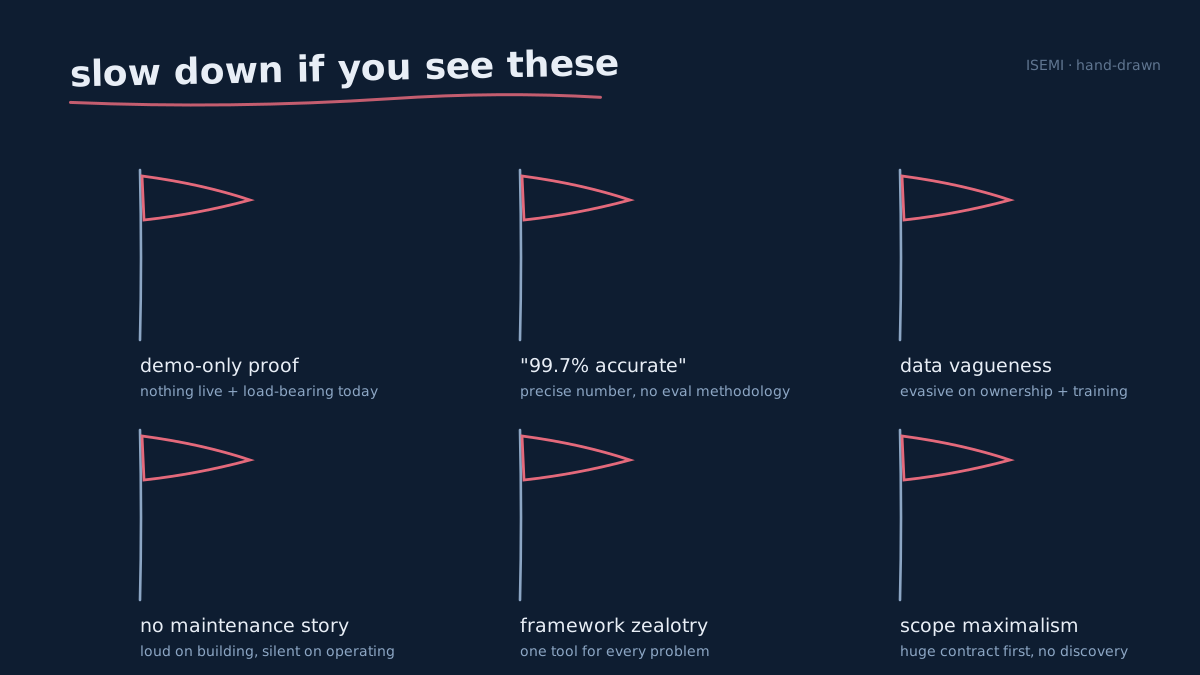
A few patterns should make you slow down, regardless of a good score elsewhere:
- Demo-only proof. Every example is a staged video; nothing is live and load-bearing today.
- Accuracy theatre. Precise-sounding claims ("99.7% accurate") with no eval methodology behind them. Real teams talk in terms of tasks, failure modes, and how they measure — not a suspiciously round number.
- Data vagueness. Evasiveness about data ownership, retention, or whether your data trains someone else's model.
- No maintenance story. Enthusiasm about building, silence about operating.
- Framework zealotry. One tool for every problem, and a reluctance to discuss when it is the wrong tool.
- Scope maximalism. Refusing to start small; pushing a large fixed contract before any discovery.
Questions to ask on the call
Bring these to the first serious conversation. The quality of the answers tells you more than any deck:
- "Show me an agent you have running in production. How long has it been live, and what breaks most often?"
- "What does your evaluation suite look like, and how do you catch a regression when a model updates?"
- "Walk me through how you connect an agent to a system like our CRM or ticketing — how do you scope its permissions?"
- "Who owns the code, prompts, and data at the end? Can you send your standard NDA and IP terms?"
- "What is the smallest first engagement you would recommend, and what would it prove?"
- "After launch, who maintains it, how fast do you respond, and what does that cost?"
- "When an agent does the wrong thing in production, how do you find out why?"
FAQ
What is an AI agent development company? It is a firm that designs, builds, and operates LLM-powered agents — software that plans tasks, calls tools and APIs, and completes multi-step work with limited supervision. Unlike a traditional dev shop, it delivers a system that makes decisions at runtime, which requires evaluation, observability, and ongoing maintenance as core competencies rather than extras.
How is it different from hiring a normal software agency? Agents are non-deterministic, they take real actions, and they need continuous care as models and tools change. So you are evaluating a team's discipline around evals, guardrails, permissions, and operations — not just their ability to ship features on a deadline.
What should I ask for as proof? Live agents in production (not demos), a described evaluation practice, an observability setup, clear code and data ownership terms with an NDA, and a concrete maintenance arrangement. Teams that build and operate their own products can usually show all of these on themselves.
How much should the first engagement be? Prefer a small, scoped discovery sprint over a large upfront contract. The goal of the first step is to de-risk: to prove the vendor can wire into your systems and produce a working slice before you commit to a full build. Reputable teams will recommend starting small.
Do I own what they build? You should — the source code, prompts, evaluation sets, and your data — with no punitive lock-in and a signed NDA before sensitive information changes hands. Confirm it in the contract; do not assume it.
Where to go next
If you are scoping an agent build, the fastest way to test a vendor against this checklist is to look at what they actually run. We build and operate our own products — Spikdi, a live consumer app, and the open-source pipelines Flow Kit and Flowboard — and we ship agents into real operations, like our AI Agent Jira Bot, which reads and writes across Jira, GitLab, Notion, Confluence, Drive, and Calendar through MCP tools.
If that is the kind of production-first team you want to evaluate, start with our AI agent development service and bring the questions above to the first call.