
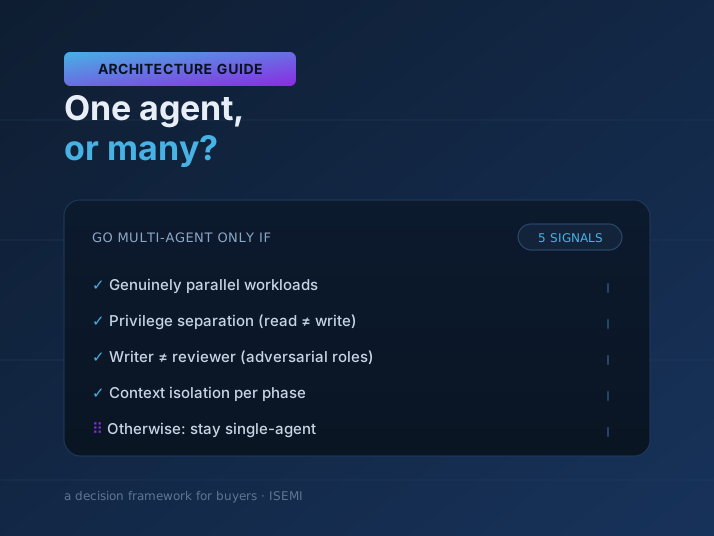
Multi-agent systems — architectures where several AI agents with distinct roles cooperate on a task — are the most over-recommended pattern in AI engineering today. They are genuinely powerful in a handful of situations, and an expensive source of complexity everywhere else. Yet "we'll use a multi-agent architecture" has become a default vendor pitch, partly because it sounds sophisticated and partly because it justifies a bigger contract.
This is a decision framework for buyers and technical leads: what a multi-agent system actually is, why a single agent should be your default, the five signals that genuinely justify going multi-agent, and how to keep the door open without paying the complexity tax up front.
What is a multi-agent system?
A single AI agent is one loop: a model receives a goal, plans, calls tools (APIs, databases, applications), observes results, and continues until done. A multi-agent system splits that work across several such loops — each with its own role, instructions, and often its own tool set — coordinated by an orchestrator, a message protocol, or a shared workspace. Typical shapes include planner-and-executors, writer-and-reviewer pairs, and fleets of parallel workers fanning out over a large workload.
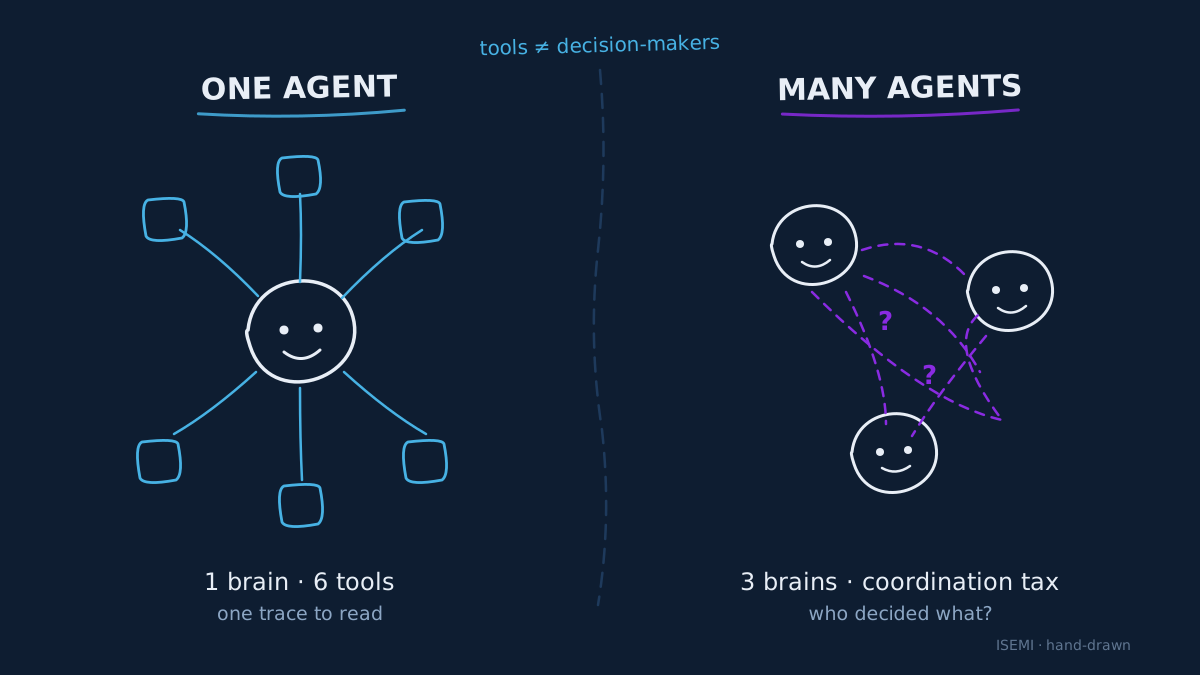
The distinction that matters is not how many model calls happen — a single agent may make hundreds — but whether there are multiple independent decision-makers whose interactions you now have to design, observe, and debug.
Why a single agent is the right default
Start from one honest observation: most tasks that get pitched as "multi-agent" are one competent agent with good tools, described with more drama.
A single agent is the right starting point because:
- You can see why it did what it did. One decision-maker produces one trace. When something goes wrong, you read one run. With five agents passing messages, a wrong outcome can emerge from the interaction — no single agent made a mistake, and yet the system did.
- Evaluation stays tractable. Testing a probabilistic system is already the hard part of agent engineering. Each additional agent multiplies the behavior space you must cover with evals.
- Cost and latency stay predictable. Agents that coordinate spend tokens on coordination. Inter-agent chatter — summaries, handoffs, re-reads of shared context — is overhead your invoice pays whether or not it improves the outcome.
- Modern models keep raising the bar for "one agent can do this." Every model generation absorbs work that previously needed decomposition. An architecture that exists to compensate for a 2024-era weakness is a liability by 2026.
If a vendor's first instinct on a scoped, sequential workflow is a multi-agent fleet, that tells you more about the vendor than about your problem — our guide to evaluating an AI agent development company has a full checklist for pressure-testing exactly this kind of proposal.
The five signals you actually need more than one agent
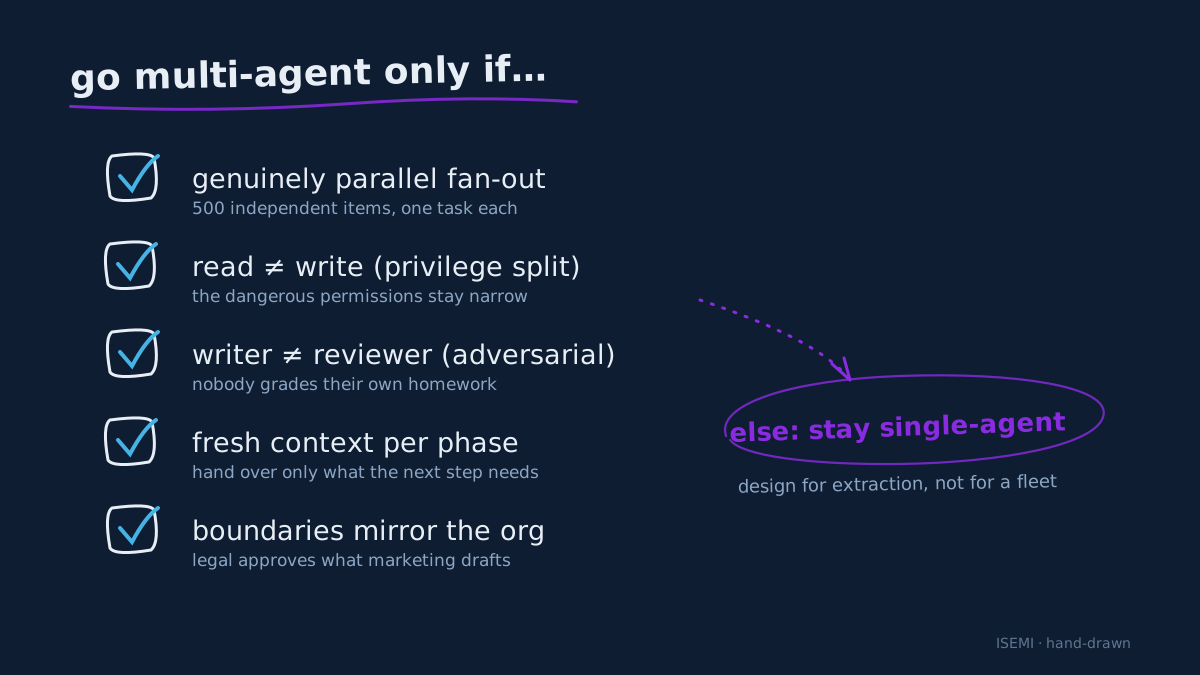
There are real cases where multi-agent is not hype but the correct engineering answer. In our build work, these five signals are what justify it:
1. Genuinely parallel workloads
If the job is "do the same independent task across 500 items" — triage this ticket backlog, analyze each of these documents, check every page of this site — parallel worker agents cut wall-clock time roughly in proportion to how many you run. The tasks must be independent; parallelizing tasks that share state buys you race conditions, not speed.
2. Privilege separation
An agent that reads everything should rarely be the agent that writes anything. Splitting read-side research from write-side execution means the component with dangerous permissions (sending, posting, paying, deleting) can be narrow, heavily guarded, and simple to audit — while the exploratory component roams safely with read-only access. This is the same least-privilege principle behind good security design, applied to agents.
3. Adversarial roles: the writer must not grade its own work
A reviewer agent with genuinely separate context and instructions catches what the author agent cannot see — the same reason human code review works. We run this pattern on ourselves: in our own 23-day product build, every milestone written by the executing agent was audited by a separate reviewer agent, which rejected substandard work on the first round more than once and forced fixes before approval. One agent reviewing its own output, by contrast, mostly agrees with itself.
4. Context isolation
Agents have finite working memory, and long-running tasks accumulate noise. When a job has cleanly separable phases with different needs — deep research here, precise code edits there, a summary at the end — giving each phase a fresh agent with a purpose-built context often beats one agent dragging an ever-heavier conversation behind it. The boundary is the point: each agent starts clean and hands over only what the next one needs.
5. Boundaries that mirror your organization
If legal must approve what marketing drafts, or the finance workflow must never touch the CRM's write credentials, agent boundaries that mirror organizational boundaries make the system easier to govern — each unit owns, configures, and audits its own agent, and the handoffs between agents match the handoffs your org already understands.
No signal firing? Stay single-agent. Several firing at once? You have a genuine multi-agent problem — design the coordination deliberately.
A real example of restraint
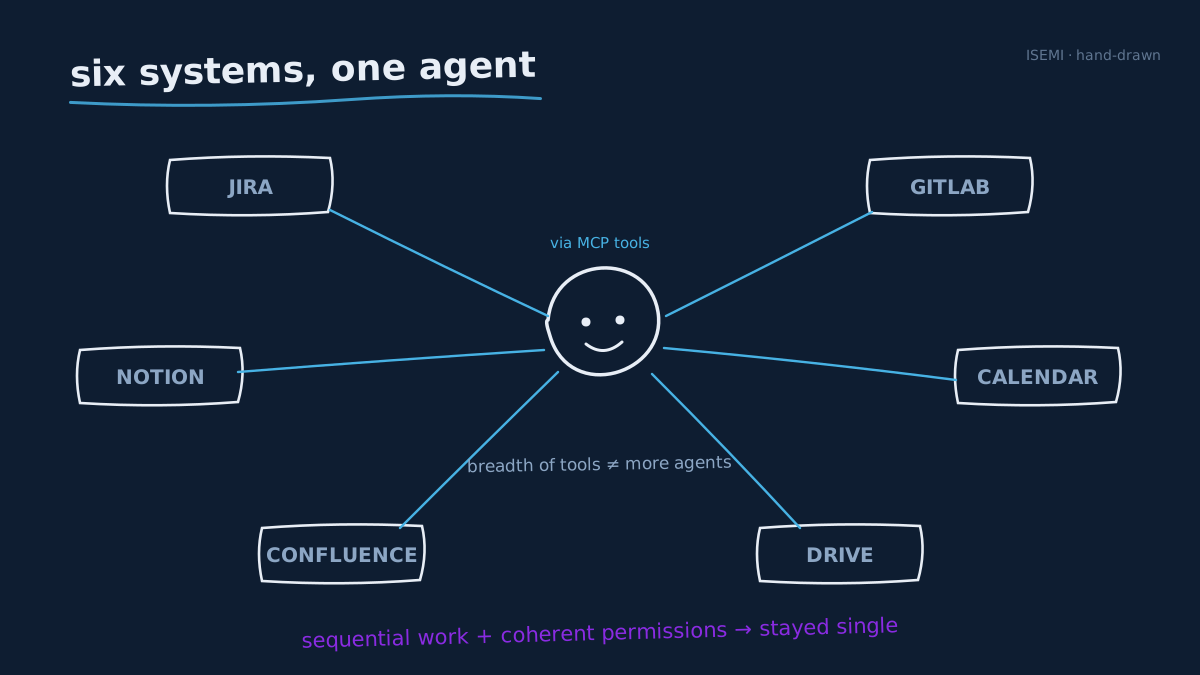
Our own AI Agent Jira Bot reads and writes across six systems — Jira, GitLab, Notion, Confluence, Google Drive, and Calendar — through MCP tools. On a whiteboard, that diagram looks like a multi-agent system: six integrations, many workflows. It isn't. Breadth of tools is not a reason to multiply agents; the work is largely sequential, the permissions are coherent, and one well-instrumented agent with six tools is dramatically easier to operate than six agents with one tool each. The number of systems you touch and the number of decision-makers you need are different questions.
What the trade-off looks like in practice
| Dimension | Single agent | Multi-agent |
|---|---|---|
| Debugging | Read one trace | Reconstruct an interaction |
| Evals | One behavior space | One per agent, plus their interplay |
| Cost | Task tokens | Task tokens + coordination overhead |
| Latency | One loop | Parallel wins on fan-out; handoffs add hops elsewhere |
| Permissions | One blast radius to guard | Narrow, separable blast radii |
| Governance | Simple ownership | Boundaries can mirror the org |
The pattern in that table is consistent: multi-agent pays off exactly where the structure of the problem — parallelism, privilege, adversarial checking, isolation, governance — does the work. It costs you everywhere the structure was decorative.
Design for extraction, not for a fleet
The practical strategy we recommend — and use — is to start with one agent, but keep its internals extraction-ready: tools defined behind clean interfaces, prompts and roles in versioned files rather than buried in code, per-step traces you can already inspect. Then, when a real signal fires — the workload becomes parallel, a reviewer step earns its keep, a permission boundary appears — promoting one responsibility into its own agent is a refactor, not a rewrite.
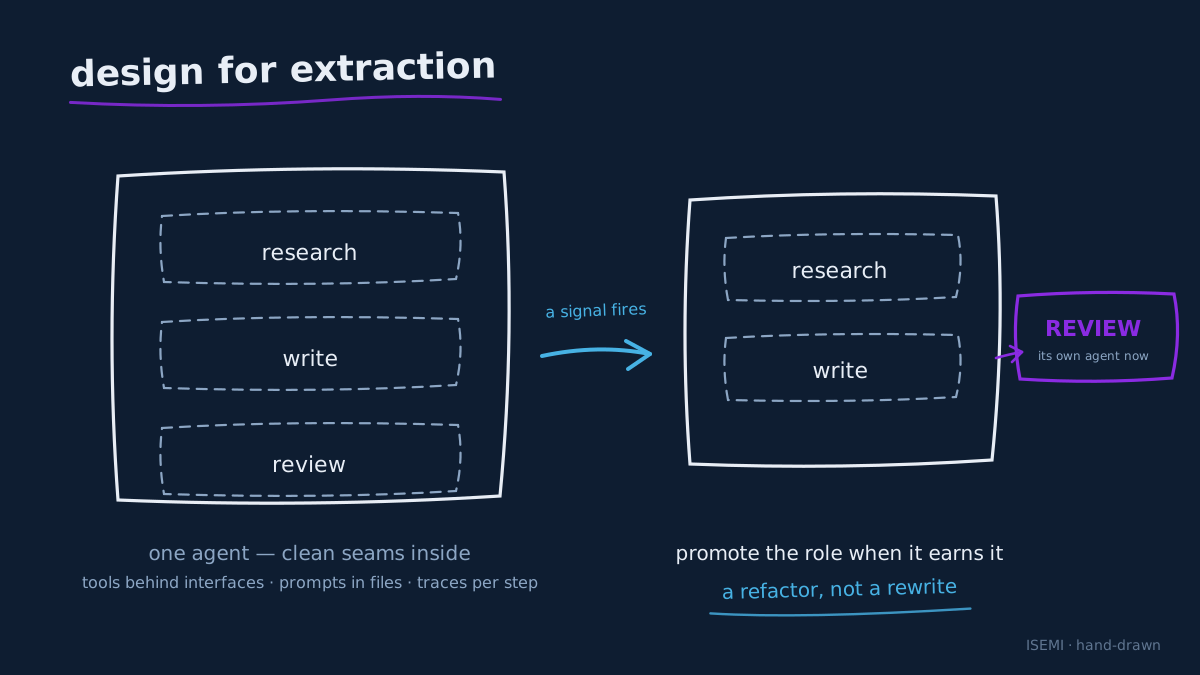
That sequencing also fixes the commercial conversation: you pay for coordination complexity when the problem demonstrates the need, not when a proposal asserts it.
FAQ
What is a multi-agent system in plain terms? Several AI agents — each its own loop of planning, tool-calling, and acting, with its own role and instructions — cooperating on a task via an orchestrator or shared workspace. It differs from one agent making many model calls: the defining feature is multiple independent decision-makers whose interactions must be designed and debugged.
Is a multi-agent system more accurate than a single agent? Not by default. Accuracy improves when roles are adversarial or complementary — a reviewer that independently checks a writer, specialists with genuinely different contexts. Splitting a task among agents without that structure usually adds coordination errors faster than it adds insight.
Is multi-agent more expensive to run? Usually. Beyond raw token spend on coordination, the larger costs are engineering: more behavior to evaluate, more traces to correlate, more failure modes. The exception is parallel fan-out over independent items, where multi-agent buys real wall-clock time for proportional token cost.
Can we start single-agent and migrate later? Yes — that is the recommended path. Keep tools behind clean interfaces, keep roles and prompts versioned, keep traces per step, and extracting a role into its own agent later is incremental work rather than a rebuild.
Which frameworks support multi-agent systems? Most mainstream agent stacks do — Google's Agent ADK, LangGraph, and CrewAI among them. The framework matters less than the design discipline: a team that can justify each agent's existence will do good work in any of them. We stay framework-agnostic and choose per problem.
Where to go next
If you are scoping an agent build and the single-vs-multi question is live, that is precisely the kind of decision a short discovery sprint settles with evidence instead of opinion. Start with our AI agent development service — and whichever vendor you talk to, make them show you which of the five signals your problem actually fires.